The West Virginia Supreme Court has agreed to allow WV SORO to file a “friend of the court” amicus brief in the appeal of an Ohio County couple whose case was dismissed for waiting too long to file for compensation for harm to their land caused by longwall coal mining subsidence.
The Circuit Court and the Intermediate Court of Appeals held that the couple had two years from the date that the coal company did longwall mining (with its planned subsidence) under their house and land to file for compensation, even though the couple had no way of knowing when that was occurring, and when initial and further subsidence might occur for months or years after the mining happened. The lower courts relied on a catchall code provision not specific to subsidence. The mining company offered to settle within two years, but only if the couple would release all claims to future subsidence damages.
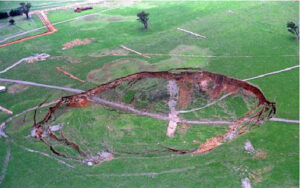
Coal mining used to be done by leaving behind some coal pillars to support the surface. But newer longwall mining moves through the coal seam in broad swaths and actually plans to let the mine roof and all the formations above it collapse into the void left by the coal removal. This subsidence can crack foundations, drain drinking water tables and even ponds, break gas and water lines, and reduce property values.
Very often, the surface owners do not own the coal and therefore receive no royalty payments from the coal being mined and sold. Courts have held that, even though the severance deed was written and signed back when everyone knew only about room-and-pillar mining, with only a chance of subsidence, the surface owner has no common law claim for the newer longwall mining, with its certainty of subsidence.
To partially remedy this situation, Congress included provisions in the Surface Mining Control and Reclamation Act, and the Legislature later included provisions in the WV Surface Coal Mining and Reclamation Act. Those are the Acts that the Ohio County couple relied on in their lawsuit, which provide surface owners with compensation for the harm caused by subsidence. Neither of those laws included a statute of limitations for filing suit.
If a federal or state law grants a right to sue for compensation and does not have a statute of limitations, then there should not be one. We think the federal agency agrees with us. And we believe these are what are called “remedial” laws, enacted because bad case law ignored the parties’ contemplation at the time of signing the severance deeds. So even if there is a statute of limitations, there is precedent in common law for what is called equitable tolling—a kind of suspension of the statute of limitations—like the rule already in some cases that a statute of limitations starts from when the person seeking damages first knew about the harm.
If there is a dug-up statute of limitations, we think longwall coal mine surface subsidence harm cries out for equitable tolling when the surface owner doesn’t even know when mining is happening. Even more so when the resulting harm might be non-existent or only slight at first, but could get worse and worse over time, and the coal company could drag out negotiations, hoping the surface owners will wait too long.
As this newsletter goes to press, we are still waiting for oral arguments in the case to be scheduled before the Court.